

DeliKing is a Thai fruit gummy brand — sold in some markets as fruit jelly — stocked by supermarkets, convenience chains and importers across Southeast Asia and the Middle East. If you distribute confectionery or imported snacks, this page covers what you would be listing, where the product already sells, and what happens after you get in touch.
Gummy or jelly?
Both, depending on where you are standing. In English-speaking markets this category is usually shelved and searched as gummy. In Thailand the same product is เยลลี่, which reads as jelly, and buyers across several Asian markets say jelly too. It is one product and one formula; only the word moves.
That choice is already printed on our packs. The Thai-market pack says jelly. The Arabic-language pack for the Middle East says gummy. Same recipe, same factory run, different word on the front, because the word a shopper reads should be the word they already use. If the pack for your market needs the other one, that is a normal part of the artwork conversation, not an exception.
What is DeliKing?
DeliKing is a fruit gummy brand owned by Deliking Food Co., Ltd., registered in Bangkok, Thailand. The range is made with 70% real fruit and 8% cane sugar, contains no preservatives, and uses carrageenan rather than gelatin, which makes it suitable for vegan and halal listings. Production runs in facilities certified to HACCP, GHPs and HALAL standards.
DeliKing is a brand owner. We develop the products and make them with partner factories in Thailand, and we work with more than one on purpose. Different items run best on different lines, so each product is made at the plant that makes it best rather than pushed through a single factory. For you that also means capacity is not tied to one site.
Where is DeliKing already on shelf?
Five markets, listed below as they stand in September 2026. Two of them are retail listings you can verify by walking into the store.
| Market | Retailers | Outlets | Status |
|---|---|---|---|
| Thailand | Gourmet Market, Tops Food Hall | 27 | On shelf |
| Malaysia | AEON Max, Bataras, Emart, Seibu TRX, Isetan KLCC, K Plus | 119 | On shelf |
| Hong Kong | Through Tops | — | Shipping |
| Kuwait | ASG, official importer | — | Importer appointed |
| Philippines | Watsons | 220 | Launching |
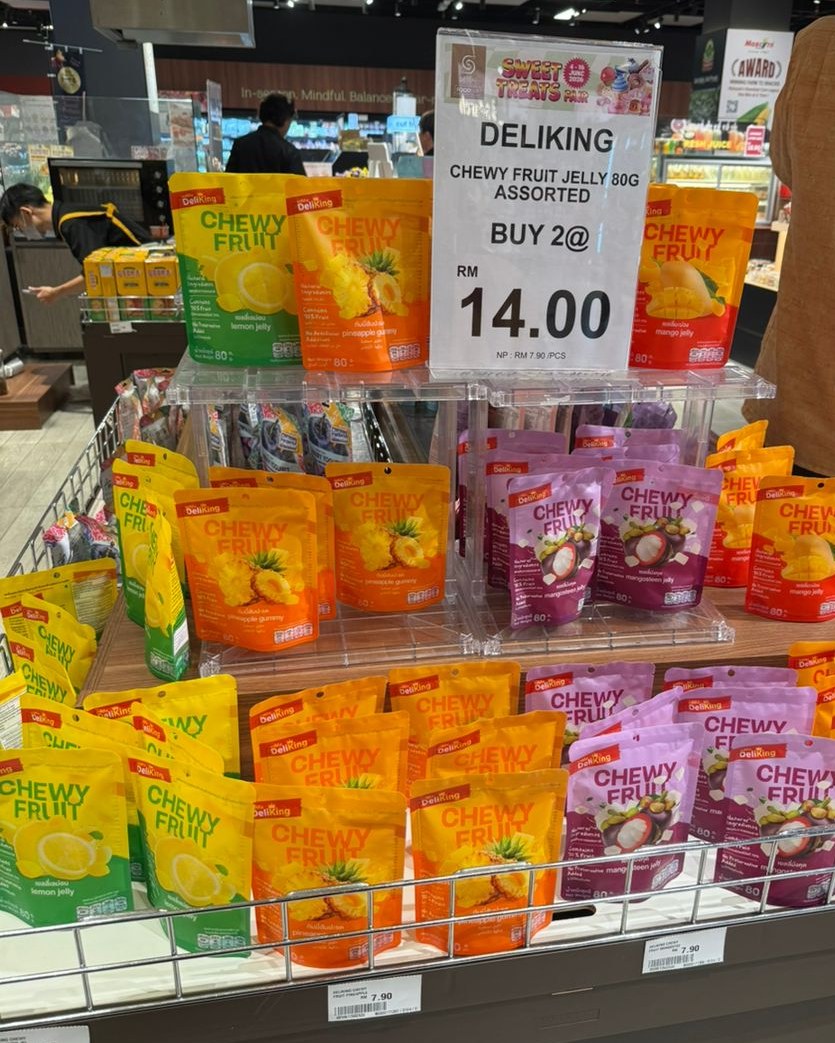
Malaysia is the most useful reference for a new distributor, because it is six different retail formats running at once: a department store food hall in KLCC, a Japanese supermarket chain, and independent chains in Sabah and Sarawak.
What is in the range?
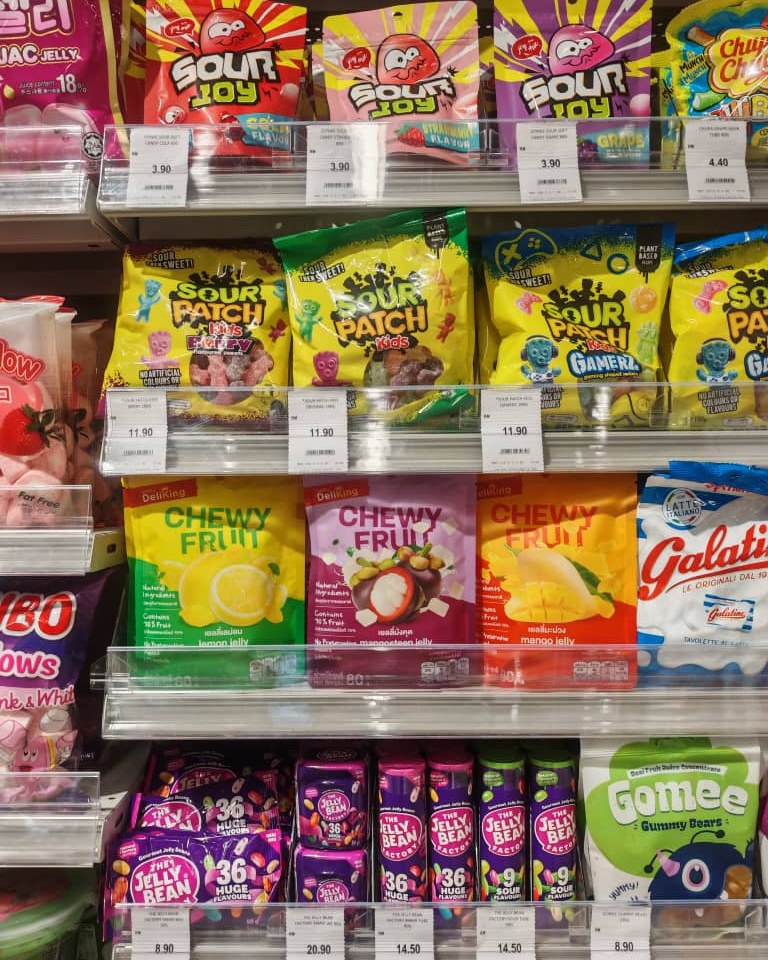
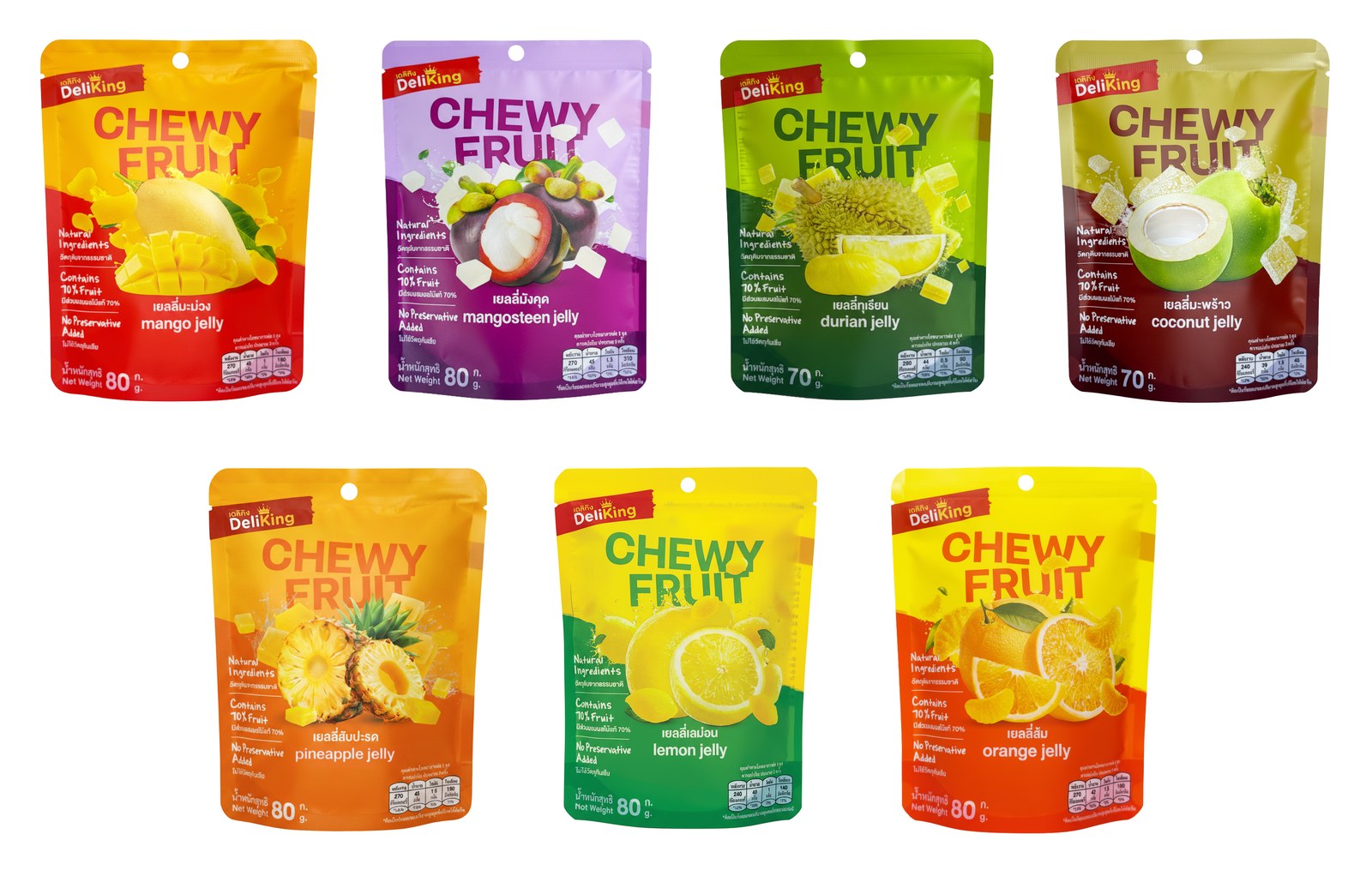
Seven flavours on one formula: 70% real fruit, set with carrageenan rather than gelatin. Five are fruits any buyer in Asia already recognises. Durian and mangosteen are the two that make the range read as Thai.
One thing buyers ask before they ask about taste: mango, orange and lemon are moulded in the shape of the fruit, roughly 4.0 × 2.5 cm each, and the other four are cubes. On a shelf where most gummy is the same bear or ring, that is something to merchandise on.
| Flavour | Pack | How it tastes | Notes for the buyer |
|---|---|---|---|
| Mango | 80 g | Fragrant and sweet with a slight tang, made with Nam Dok Mai mango | The flavour that has opened every market so far. Moulded as the fruit |
| Durian | 70 g | Creamy and smooth, carrying the Mon Thong aroma buyers expect | The one buyers ask about first, and the one that decides whether the range reads as Thai |
| Mangosteen | 80 g | A sweet-tangy balance, with no colour added, so the piece is naturally translucent | Rare in this category. Strongest with tourists and gift buyers |
| Coconut | 70 g | Aromatic and only mildly sweet, with 2% real coconut flakes for texture | Our strongest flavour with Chinese consumers |
| Orange | 80 g | Fresh citrus aroma, sweet with a hint of tart | Broad appeal, nothing to explain. Moulded as an orange segment |
| Lemon | 80 g | Honey-lemon, with a clear lemon-oil aroma. Refreshing rather than sharply sour | Not a sour candy, which is worth saying to any buyer who assumes lemon means sour |
| Pineapple | 80 g | Phulae pineapple aroma, juicy and tropical | Currently produced with Arabic-language artwork for the Middle East, so tell us early if your market wants it |
Why does it hold a shelf?
Because it answers three questions a shopper asks at the same time: is it real fruit, can I eat it, and will it survive the trip home. The formula is built around those.
- 70% real fruit and 8% cane sugar. The fruit content is the first thing a buyer checks against whatever is already in the category.
- No preservatives. Colour and flavour come from natural sources.
- Carrageenan, not gelatin. One formula covers vegan shoppers and halal listings, so you are not managing two SKUs for one shelf.
- Heat stable. It does not slump in a warm supply chain, which matters on tropical routes and in unairconditioned back-of-store.
- Chewy, soft and non-sticky. The texture is the repeat-purchase driver.
What certifications come with it?
| Certification | What it covers | Why your market may need it |
|---|---|---|
| HALAL | Compliance of ingredients and process with halal requirements | Entry condition across the GCC, Malaysia and Indonesia |
| HACCP | Food safety hazard control at the manufacturing site | Standard request in retailer and importer supplier audits |
| GHPs | Good hygiene practices underpinning HACCP | Usually requested together with HACCP |
| US FDA registration | Facility registration with the US Food and Drug Administration | Required before product may enter the United States |
The dietary profile usually gets checked in the same breath: the range is vegan and gelatin-free, halal certified, gluten-free and dairy-free, with no artificial colours or flavours and no preservatives.
Specification sheets and test reports are part of the standard document pack. If your filing needs something beyond it, such as a certificate of origin, a health certificate, or specific language on the label, tell us at the enquiry stage and we will confirm what we can issue.
How does a first order work?
A full container is where the economics usually land for an importer. That is the volume at which freight per carton, clearance costs and your landed price work together well enough to leave a margin. For a first order we are more flexible than that, because the point of a first order is to get the product onto a shelf and see how it sells.
We can start the conversation at 60 cartons. That is one pallet, 4,500 packs in the standard carton or 3,600 in the distribution carton, and it is the smallest quantity where a shipment still makes sense on cost. It is also enough to list several flavours rather than betting the whole launch on one.
| Order | What it is for | What we will talk about |
|---|---|---|
| From 60 cartons one pallet, first order |
Getting listed, testing which flavours move in your market, proving sell-through to your own buyer | Flavour mix, packaging and label requirements for your market, shipping arrangement |
| Full container the working volume |
The volume that makes the landed cost per carton work for ongoing business | Pricing, forecast and reorder rhythm, marketing support for the launch |
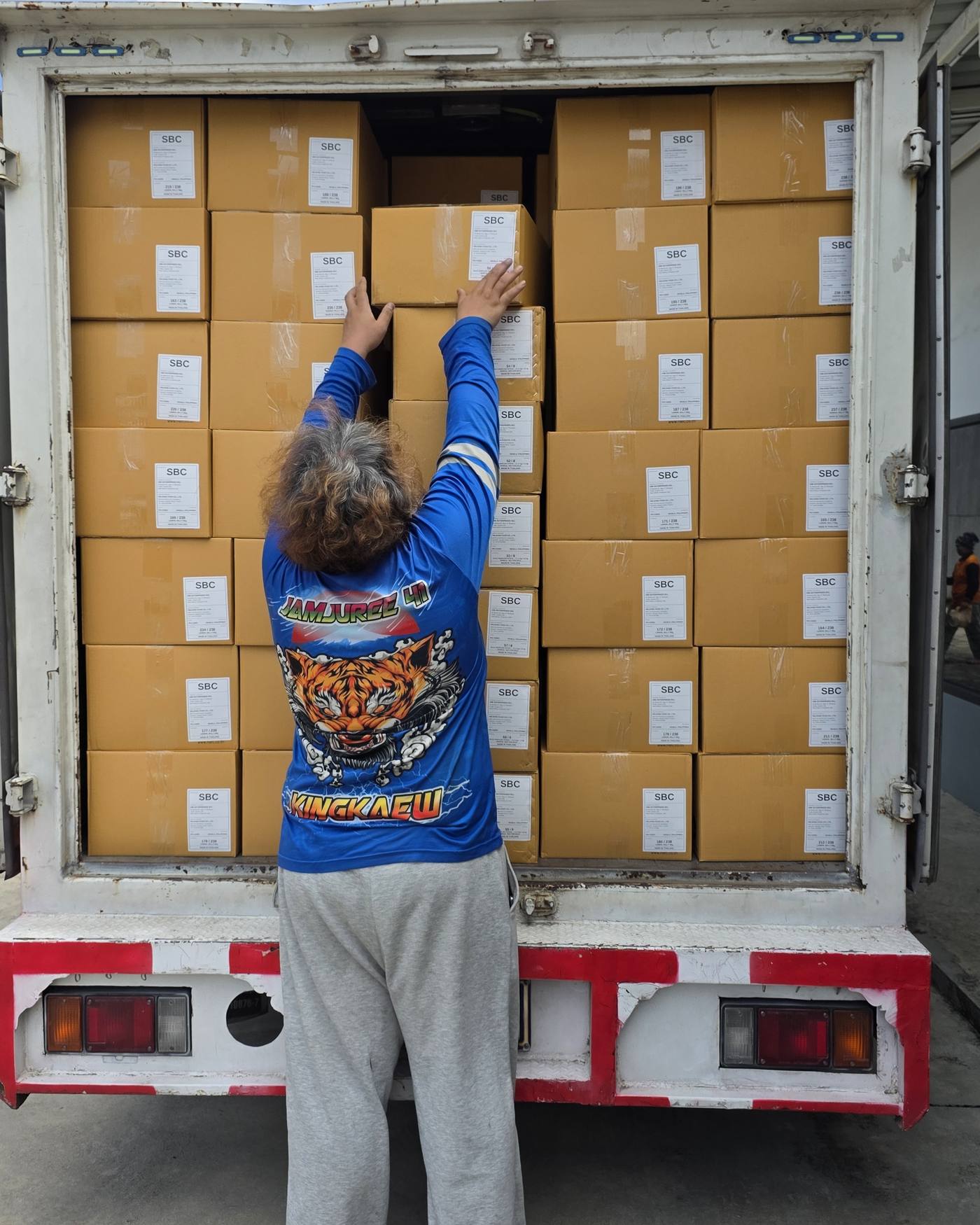
The production clock starts when the order is confirmed and the deposit has reached us, not when the first enquiry arrives. Worth planning around if you are working back from a retailer’s listing date.
The numbers behind that, such as units per carton, pallet configuration, shelf life, lead time and the shipping terms we quote on, are in the next section. Anything past them, such as documents for your import filing or how a specific market’s labelling has to be handled, is a question rather than a page. Ask us and you get a direct answer, not a brochure.
- Send an enquiry — the form goes straight to the export team, and it is the fastest route to a quote
- See the full range — seven flavours, pack sizes and what is in them
- Where DeliKing already sells — the retailers and branches, if you want to look at the product on a shelf first
- Finding DeliKing in a Thai supermarket — the 27 Thai branches, the aisle they sit in, and which flavour to pick
- For Business — wholesale, OEM and export terms gathered on one page
What are the pack, pallet and shipping specifications?
Here is what an importer needs to cost a shipment before talking to anybody. These are the standard figures; a different packing configuration can be discussed if your retailer’s planogram or your freight arrangement calls for one.
| Specification | Standard | What it means for you |
|---|---|---|
| Units per carton | 75 packs or 60 packs |
Two configurations in the same size carton. 75 packs loose is the standard. 60 packs as five shrink-wrapped bundles of twelve is the distribution carton, for buyers servicing a long list of supermarket, convenience and hypermarket doors |
| Cartons per pallet | 60 cartons | The carton is the same size either way, so a pallet is 60 cartons in both cases: 4,500 packs loose, or 3,600 packs bundled. One pallet is also our first-order starting point |
| Carton size and weight | 48 × 35 × 20 cm 5.95–6.70 kg gross |
The same carton in both packing configurations, so your pallet and container maths does not change with the one you choose |
| Shelf life | 18 months | Room for sea freight, clearance and a full sell-through cycle on shelf. Store at room temperature in a dry place, out of direct sunlight |
| Lead time | 15–60 working days | From the day the order is confirmed and the deposit is received, to shipment. Where you land in that range depends on the flavour mix and on whether your market needs its own label artwork |
| Incoterms | EXW, FOB, CFR | Collect at our door, take over at the Thai port, or have us ship to yours. Under CFR cargo insurance is yours to arrange |
| HS code | 2007.99.90 | The heading we declare under. Check the duty rate it attracts in your own tariff before you cost the landing |
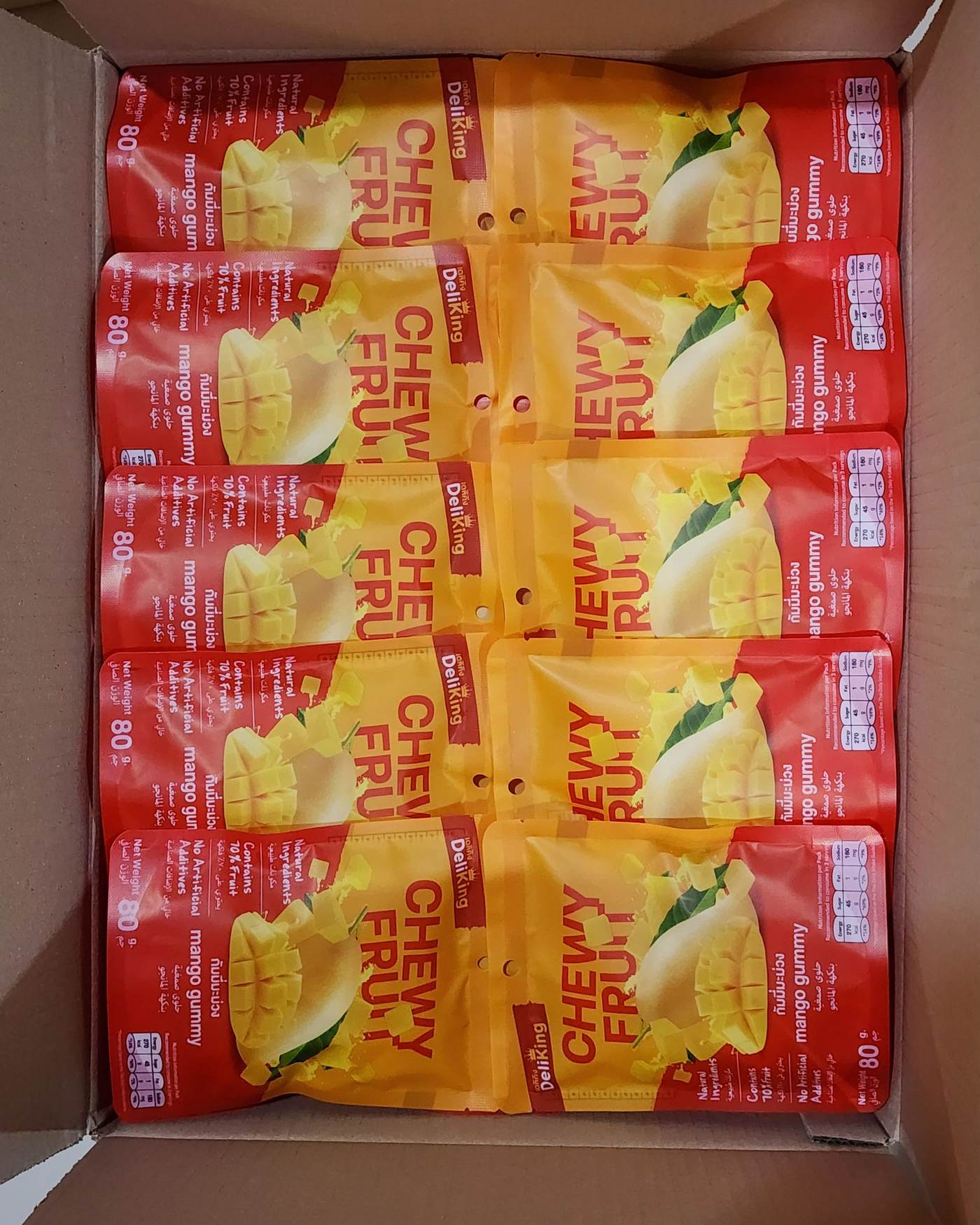
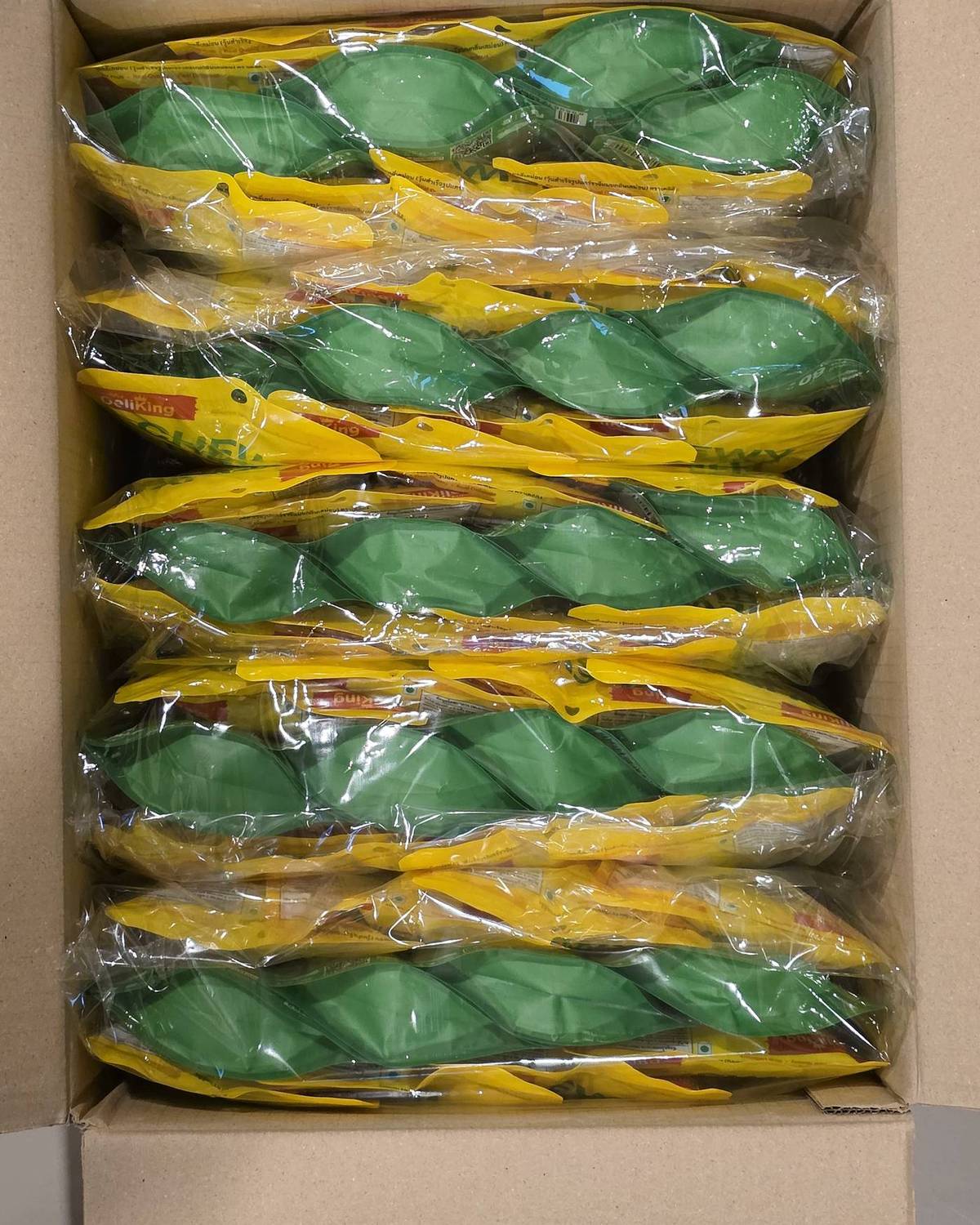
Which carton you take depends on how you move stock. If your warehouse breaks bulk and picks per store, the 75-pack carton gives you the lowest cost per pack. If you are servicing many retail doors at once, the 60-pack carton arrives as five ready-made drops of twelve, so a store order leaves your warehouse without anyone opening a bundle. Same carton size, same pallet count, and you tell us which one you want at the order stage.
The lead-time range is wide for an honest reason: a repeat order of flavours already packed for your market sits at the short end, while a first order that needs market-specific artwork, a new label filing or a production run sits at the long end. Wegive you a date at the time of order rather than an average.
What support does a distributor get?
It depends on the agreement, and we would rather say that plainly than publish a package that turns out not to fit your market. What is on the table from the start is marketing support to open the market and marketing materials. The scale of both follows the scale of the commitment, which is what the first conversation is for.
If your retailer needs something specific for a listing submission, tell us what the form asks for and we will tell you what we can produce.
Is territory exclusivity available?
It can be, and it is something we negotiate rather than something the first order carries automatically. Exclusivity follows two things: a marketing commitment to actually open the market, and a sales volume you are prepared to stand behind.
That is a deliberate position. A distributor who is building the brand in their territory has a fair claim to be protected while doing it, and we would rather protect them than let a second importer undercut the work. A territory held open while somebody decides whether to try is a shelf nobody is selling from. Bring a plan and a number to the first conversation and exclusivity is on the table with them.
Frequently asked questions
Is DeliKing halal certified?
Yes. The range is halal certified, and it uses carrageenan rather than animal-derived gelatin, so there is no animal-origin question to resolve during an import filing.
Is it suitable for vegans?
Yes. The gelling agent is carrageenan, which is seaweed-derived. There is no gelatin in the range.
What is the shelf life?
18 months. That leaves room for sea freight and clearance and still gives your buyer most of the window on shelf.
How long is the lead time?
15 to 60 working days, counted from the day the order is confirmed and the deposit is received. A repeat order of flavours already packed for your market is at the short end; a first order that needs its own label artwork or a production run is at the long end. You get a date at the time of order.
How many packs are in a carton?
Two options. The standard carton holds 75 packs loose. The distribution carton holds 60 packs, as five shrink-wrapped bundles of twelve, in the same size carton. A pallet is 60 cartons either way, so 4,500 packs loose or 3,600 packs bundled.
Which Incoterms do you quote?
EXW, FOB and CFR. If you already have a forwarder in Thailand, FOB is usually the simplest. If you would rather we arrange the sea freight to your port, CFR does that, and cargo insurance stays on your side.
Do you offer private label or OEM production?
Yes, alongside our own brand. Most of our business is DeliKing-branded product sold through distributors and retailers; private label sits beside it rather than in front of it. If that is what you are looking for, say so in your first message and we will route it accordingly.
Which flavours should a new market start with?
Mango has opened every market so far. Durian and mangosteen are the two that make the range recognisably Thai, and they are the ones tourists and gift buyers look for. Add coconut where a large share of your shoppers are Chinese; it is the strongest flavour we have with that group.
Can you supply documents for our import filing?
Yes. Specification sheets, manufacturing flow and analysis reports are standard. Tell us the market and we will confirm what else we can issue before you file.
Who do I talk to?
Use the enquiry form on our For Business page. Include your market, the retail channels you serve, and roughly what volume you are planning for a first order. It reaches the person who can answer rather than a general inbox.
Start the conversation
Tell us where you sell and what you are trying to put on the shelf. If DeliKing is a fit we will send the specification pack and pricing; if it is not, we will say so. Send it through the contact form and it reaches the export team directly.
Deliking Food Co., Ltd. · 98/37 Soi Ramintra 23, Anusaowri, Bangkhen, Bangkok 10220, Thailand · Tax ID 0965566000497