

DeliKing is on shelf in 119 stores in Malaysia, through six separate retailers. No single chain carries the brand there. The footprint was built retailer by retailer, in four different kinds of store, over roughly a year.
Malaysia is the most useful reference we can give a buyer in a new market, because it was not one listing that went well. It was six, each with its own buyer, its own format and its own reason for saying yes.
Which Malaysian retailers stock DeliKing?
| Retailer | Outlets | Format |
|---|---|---|
| AEON Max | 48 | Japanese-owned supermarket chain |
| Bataras | 39 | Independent chain, East Malaysia |
| Emart | 28 | Independent chain, East Malaysia |
| Seibu TRX | 2 | Department store food hall, Kuala Lumpur |
| Isetan KLCC | 1 | Department store food hall, Kuala Lumpur |
| K Plus The Curve | 1 | Supermarket, Klang Valley |
| Total | 119 | Six retailers, four store formats |
Why does one market need six different retailers?
Because Malaysia is not one retail market. It is at least three, and they do not share buyers.
Peninsular Malaysia has the national chains and the Kuala Lumpur department store food halls. East Malaysia — Sabah and Sarawak — is served largely by strong independent chains that do their own importing and have their own category buyers. A listing in one does nothing for the other.
The split is the part most people get wrong. The two East Malaysian independents account for 67 of the 119 outlets — more than half the Malaysian footprint. The national supermarket chain, which is the name a brand owner thinks of first, is 48. The three department store doors are a rounding error by volume and are not there for volume.
| Channel | Outlets | Share | What it is for |
|---|---|---|---|
| East Malaysian independents | 67 | 56% | Volume, and a region the national chains serve thinly |
| National supermarket chain | 48 | 40% | Reach, repeat purchase, and a reference other buyers recognise |
| Department store food halls | 3 | 3% | Visibility and positioning, not volume |
| Other supermarket | 1 | 1% | A single-door trial that opens a chain |
Where does the range sit inside the store?
In the main confectionery aisle, beside the international gummy brands. At AEON Max, photographed in December 2025, the range sits between Sour Patch Kids on the shelf above and The Jelly Bean Factory on the shelf below, with Chupa Chups and Sour Joy in the same bay.
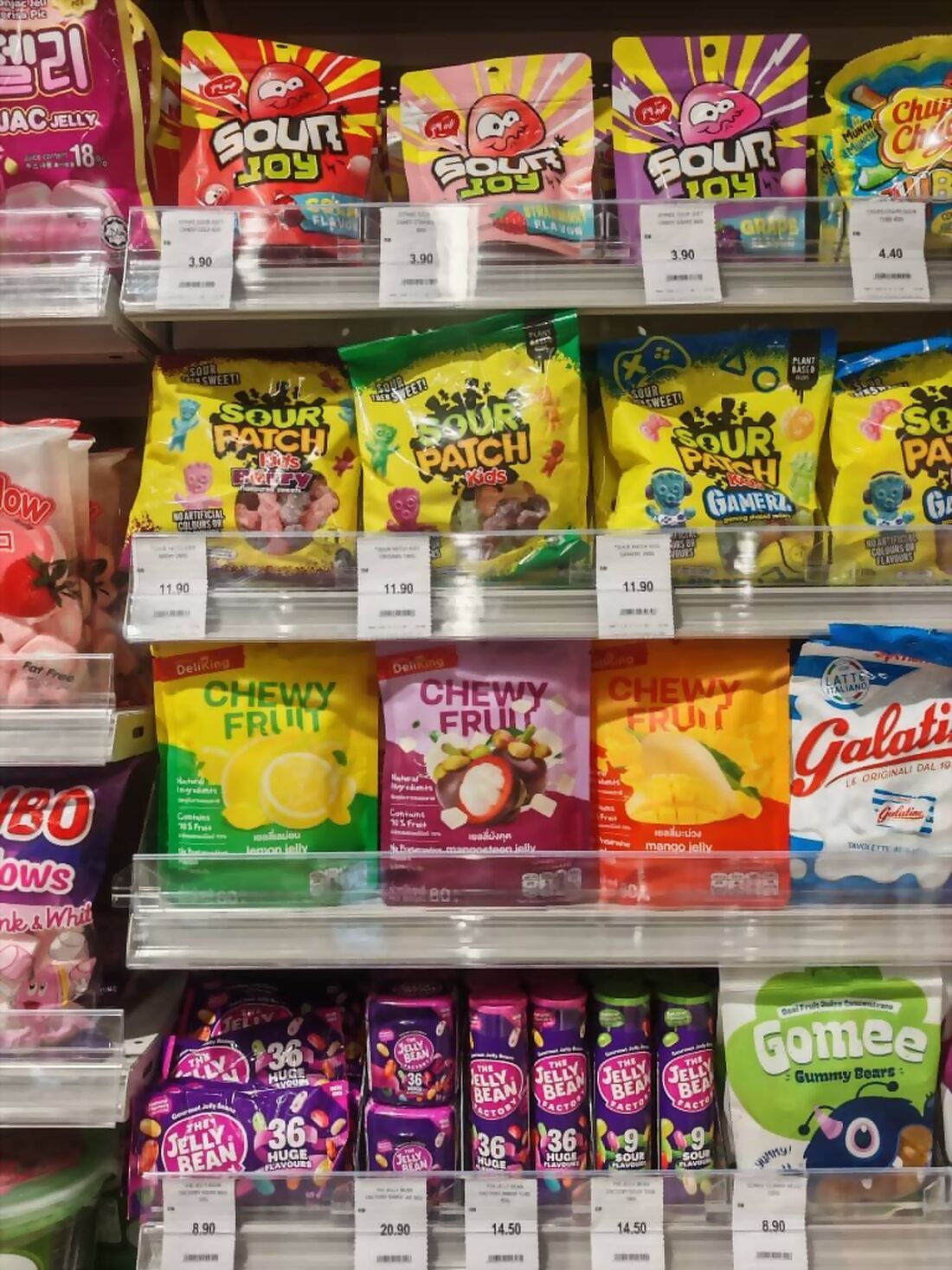
That placement is the single most useful fact in this whole post, and it is worth explaining why. A product shelved in an imported-foods bay is bought by people who went looking for imported food. A product shelved in confectionery is bought by people who came for sweets and chose it over the alternative next to it. The second shelf sells more, and it is harder to get.
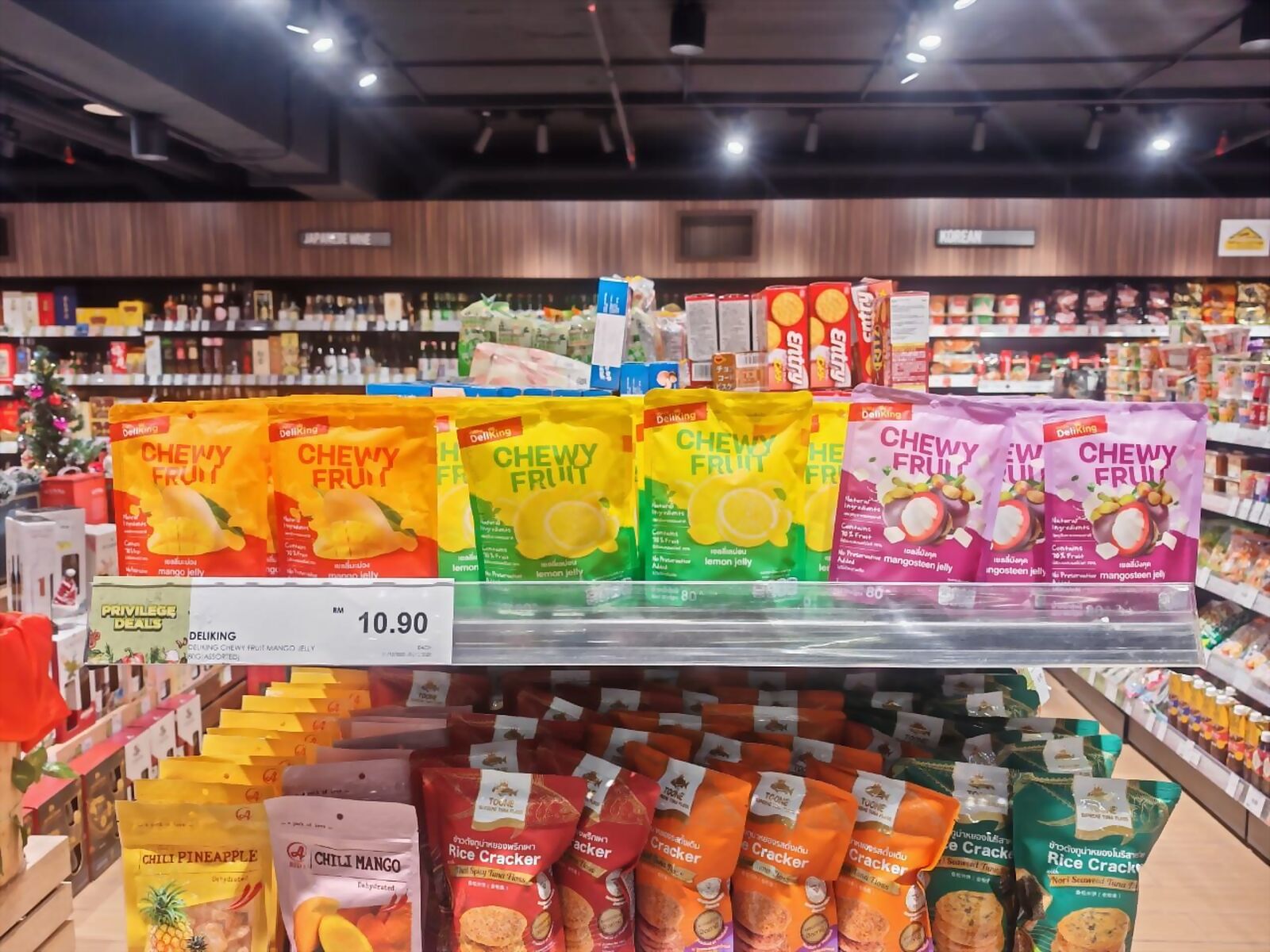
It is not the only placement. At AEON Max the range also holds a second block in the Asian snack bay, above the Thai rice crackers and dried fruit, under the retailer’s own Privilege Deals shelf tag. Two bays in one store is better than one, but the confectionery facing is the one that moves the sales rate.
What kind of display has the product earned?
Shelf space is given once. Anything beyond shelf space is given again each time, and it is the clearest signal a retailer can send about how a product is actually selling.
- Multiple facings in the fixture. Several flavours side by side in the permanent set, not a single facing squeezed in at the end of a shelf.
- Secondary displays. Crate-style end caps and free-standing units away from the main aisle, which a retailer only builds for products it expects to move.
- The retailer’s own promotional card. At Seibu TRX the multibuy card on the display is the store’s artwork, not ours. A retailer printing its own sign for a brand is a stronger statement than anything the brand can print for itself.
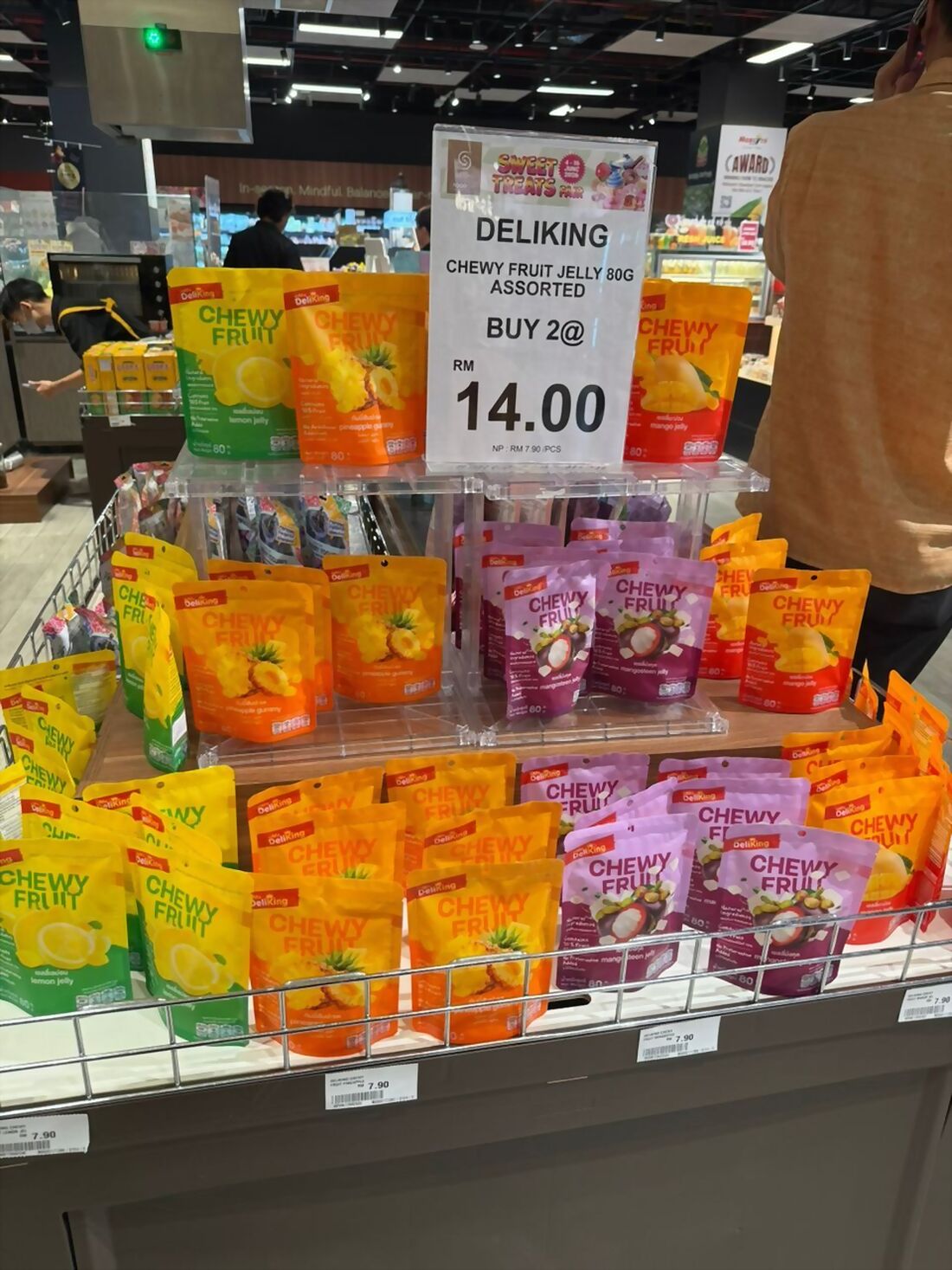
In-store prices in these photographs are set by each retailer. We do not set them and do not publish them.
Why does halal matter for a gummy in particular?
Because of gelatin. Most gummies on a Malaysian shelf are set with animal gelatin, which makes sourcing the first question a buyer asks and a slow one to answer.
DeliKing is set with carrageenan, a gel from red seaweed, so there is no animal ingredient to trace. The range is halal certified, and it is vegan and gelatin-free for the same reason. That removes a conversation rather than winning one.
The documents an importer has to file in Malaysia are a separate subject and get their own guide. This post is about what happened on the shelf.
What does Malaysia tell a buyer in another market?
Four things, and they are the reason we write this market up rather than just citing the number.
- A country is not a listing. Budget for several buyers, not one. The one that delivers the most doors may not be the one with the most famous name.
- A small door can be worth more than its volume. Three department store food halls move very little stock and are quoted in every conversation that follows.
- Ask where the product will be shelved before you agree the terms. The aisle decides the sales rate, and it is easier to negotiate before the first order than after.
- Regional independents are not a consolation prize. In this market they are the majority of the footprint.
What would a first order into a market like this look like?
The same as anywhere else: from 60 cartons, which is one pallet. That is 4,500 packs loose at 75 per carton, or 3,600 packs at 60 per carton in shrink-wrapped bundles of 12 for distributors servicing many doors.
Lead time is 15 to 60 working days from order confirmation and receipt of the deposit. Shelf life is 18 months, and the product is heat-stable because of the carrageenan, which is what makes a tropical sea freight route uneventful.
The full terms, the certifications and the range are in Become a DeliKing Distributor. The overview sits on For Business, and the seven flavours are on Products.
The short version
- 119 outlets in Malaysia, across six retailers and four store formats.
- AEON Max 48 · Bataras 39 · Emart 28 · Seibu TRX 2 · Isetan KLCC 1 · K Plus The Curve 1.
- East Malaysian independents are 67 of the 119 — the majority.
- Shelved in the main confectionery aisle beside international brands, with a second block in the Asian snack bay at AEON Max.
- Halal certified, set with carrageenan rather than gelatin.
- First order from 60 cartons, one pallet, 15–60 working days from deposit.